

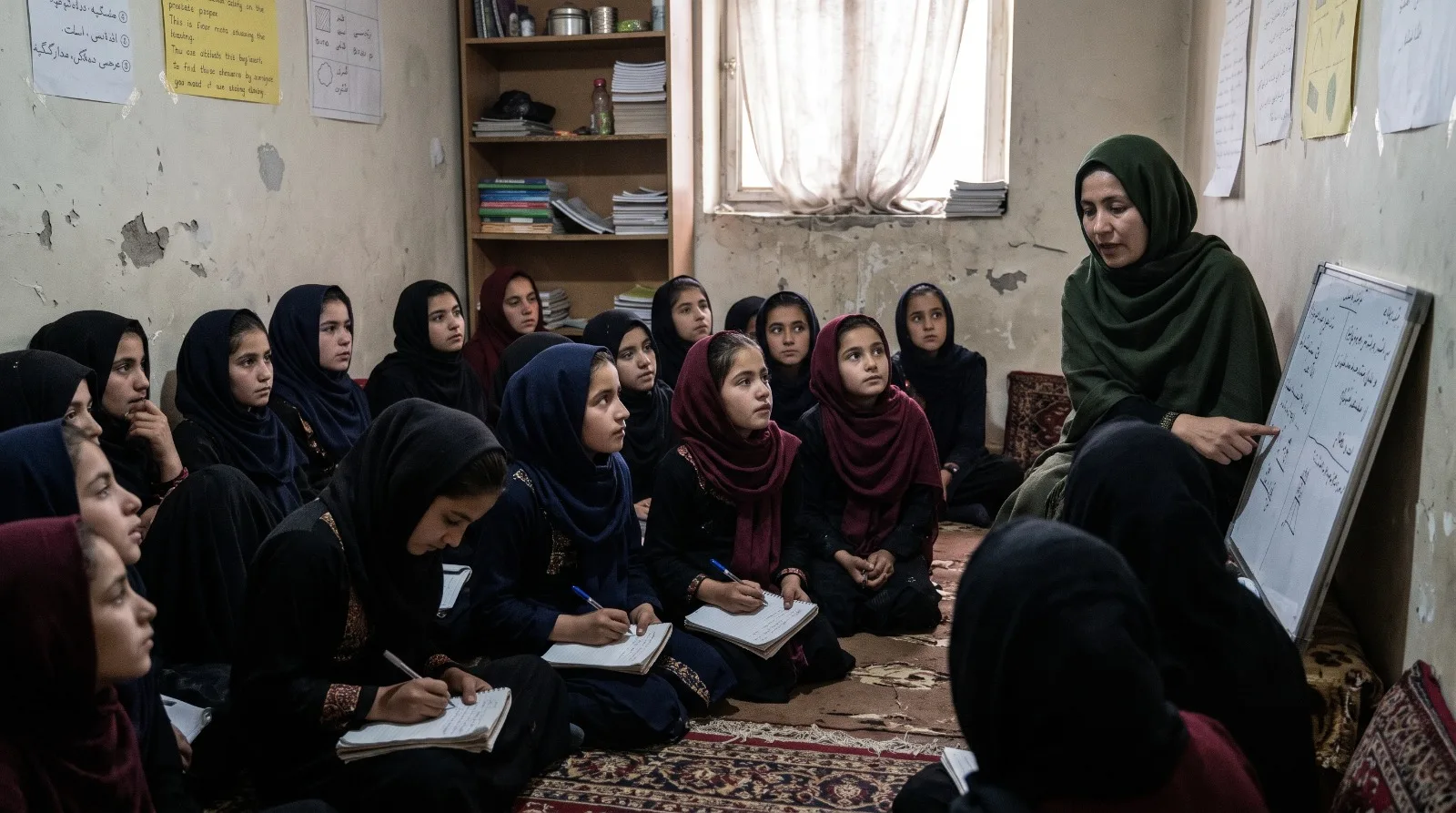
More than five years have passed since Afghanistan entered one of the darkest chapters in its modern history. Since the Taliban returned to power, millions of Afghan girls have been deprived of their fundamental right to education, women have been systematically excluded from public life, and an entire generation has been forced to live under restrictions that have stripped them of freedom, dignity and opportunity.
As a male reporter, I believe that remaining silent in the face of such injustice is not an option. The suffering of Afghan women and girls is not merely a women's issue; it is a national tragedy, a human rights crisis and a moral responsibility for every Afghan, regardless of gender.
The Taliban's treatment of women raises serious questions about the ideology, political objectives and legitimacy of their rule. Their policies have systematically targeted women's education, employment, freedom of movement and participation in society. Girls have been prevented from attending secondary schools and universities, while women have faced severe restrictions on working, studying and contributing to their communities.
These are not isolated decisions. They form part of a wider system of exclusion that has pushed women out of public life and attempted to make them invisible in their own country.
The Taliban claim to govern in the name of Islam. However, their restrictions on women's education and their systematic denial of basic rights stand in profound contradiction to the Islamic values of knowledge, justice, dignity and human responsibility. Education is not a privilege reserved for men. The pursuit of knowledge is a fundamental value in Islam, and denying women access to education cannot be justified by using religion as a political instrument.
It is important to distinguish between Islam, a religion followed by millions of people around the world, and the Taliban's political ideology and interpretation of religion. Their policies should not be accepted as a representation of Islam or the beliefs of ordinary Muslims.
The Taliban movement has a history of armed violence, intimidation and terrorist activity. Its return to power has created an environment in which fundamental freedoms are severely restricted. Many Afghans and observers see the movement's political project as one built on coercion, ideological control and the systematic exclusion of women. Its actions must be judged by their consequences, not by the religious language used to defend them.
Behind every closed school door is a human story. There is a girl who wanted to become a doctor, a student who dreamed of becoming an engineer, a young woman who wanted to become a teacher, and a daughter whose parents hoped to see her graduate from university.
More than five years of lost educational opportunities represent far more than statistics. They represent lost time, interrupted ambitions, emotional suffering and a generation whose future has been placed in uncertainty.
If Afghan girls had been allowed to continue their education, thousands would have graduated, entered universities, developed professional skills and contributed to the reconstruction and development of Afghanistan. Instead, their potential has been deliberately restricted by policies imposed by the Taliban authorities.
The consequences extend beyond individual families. A country that excludes half of its population from education and public participation damages its own future. Afghanistan cannot develop economically, socially or intellectually while women are denied the opportunity to participate in building their society.
As a male reporter, I consider it my responsibility to speak about this injustice. Defending women's rights does not make a man an opponent of his religion, culture or country. On the contrary, standing against oppression is a responsibility rooted in humanity, justice and moral courage.
The question is not whether Afghan women deserve education, employment and freedom. These are fundamental rights that should never have been taken away in the first place. The real question is how long the international community, human rights organisations and the wider Muslim world will allow this systematic exclusion to continue without meaningful action.
Afghan women are not asking for special privileges. They are demanding the rights that belong to every human being: the right to learn, work, think, choose and live with dignity.
Despite years of oppression, Afghan girls have not surrendered. Many continue to study through informal education, online courses and whatever opportunities remain available to them. Their determination demonstrates that knowledge cannot be permanently suppressed and that dreams cannot be erased simply by closing the doors of schools.
The Taliban may control institutions and impose restrictions, but they cannot own the minds, intelligence or aspirations of an entire generation.
Afghanistan belongs to all Afghans: men and women, boys and girls. No sustainable future can be built by excluding half of the population. No genuine peace can exist without justice, and no society can claim moral progress while denying girls the right to learn.
The world must not forget Afghanistan's women and girls. Their suffering must not become an ordinary headline, and their stolen years must not disappear from international attention.
A government that fears educated women fears the power of knowledge. A political movement that silences girls cannot claim to be building a just society. And no one should be allowed to use the name of Islam to justify oppression.
Afghan girls deserve their classrooms back. They deserve their universities, their freedom and their future. Above all, they deserve to live in a country where their gender is never a reason to deny them their rights.
MOHAMMAD FAHIM AZİMİ


Community discussion
No comments yet
Be the first to share a thoughtful response.